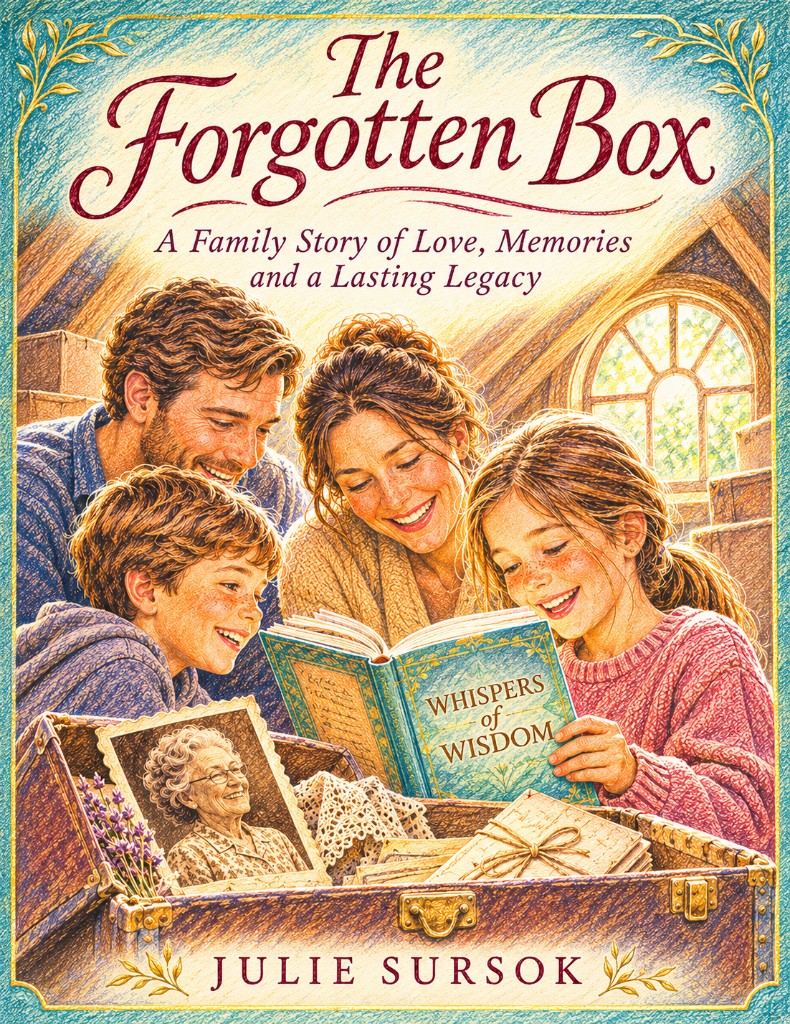
An original story inspired by Whispers of Wisdom, a Grandparent’s Journal of Memories and Life Lessons for You, by Julie Sursok.
A story about the things we leave behind, the questions we never thought to ask, and a grandmother whose words travelled through time to find the family she loved.
Chapter One — The House That Remembered
The house had been empty for almost eight months.
Not abandoned. Not forgotten. Just waiting.
It stood at the end of a quiet street, behind a white picket fence that had long since lost its perfect paintwork. A climbing rose had wrapped itself around the front veranda, and the old brass doorbell still worked, although nobody could remember the last time someone had pressed it.
For three generations, the house had belonged to the same family.
Now it was time to sell.
Emma stood at the front gate, looking up at the windows.
She remembered visiting as a little girl. Christmas mornings. Birthday parties. The smell of roast dinners drifting down the hallway—the little cupboard beneath the stairs where she and her cousins used to hide.
Her mother, Sarah, was already inside, sorting through cupboards and making lists.
Emma had brought her two children, twelve-year-old Sophie and nine-year-old Oliver, to help.
Although, judging by the way Oliver was dragging a stick along the fence, she suspected he might be more interested in discovering spiders than packing boxes.
“Are we keeping anything?” Sophie asked.
“Some things,” Emma replied. “Things that matter.”
“How do you know what matters?”
Emma looked at the house again.
“That’s a very good question.”
Inside, the rooms seemed smaller than Emma remembered.
The dining table where the family once squeezed twelve people around Christmas lunch was gone. The curtains had been taken down. Dust marked the places where pictures had hung for decades.
Only the grandfather clock remained in the hallway.
Tick.
Tock.
Tick.
Tock.
Somehow, it made the empty house feel alive.
Sarah appeared from the kitchen carrying a cardboard box.
“There’s not much left downstairs,” she said. “But the attic…”
She stopped, rolling her eyes.
“Your grandfather never threw anything away.”
Emma laughed.
“Neither did you, Mum.”
“That’s different. I keep important things.”
“And Grandad kept everything.”
They smiled.
It was the kind of conversation families have when they are trying not to talk about what they have lost.
Sarah pointed towards the narrow staircase.
“Come on. Let’s see what treasures your grandfather left us.”
None of them knew how right she was.
Chapter Two — The Forgotten Box
The attic smelled of timber, dust and old cardboard.
Sunlight slipped through a small, round window, illuminating tiny particles drifting lazily through the air.
Oliver immediately discovered an old cricket bat.
Sophie found a box of Christmas decorations, including a glass angel with one broken wing.
Emma opened a suitcase filled with photographs.
Sarah stood in the middle of the room, hands on her hips, surveying the chaos.
“Good heavens,” she muttered. “Where do we even start?”
There were boxes marked Kitchen, Winter Clothes, Christmas 1987, and Keep — Important.
Naturally, the box marked Keep — Important contained three broken lamps, an instruction manual for a television nobody owned, and a collection of rubber bands that had turned brittle with age.
They worked for almost an hour.
Then Sophie noticed something.
Behind an old wooden rocking chair, half-hidden beneath a faded blanket, sat a small cardboard box.
Unlike the others, it had been carefully sealed with brown packing tape.
Across the top, in faded blue ink, someone had written:
Margaret’s Things.
“Mum?”
Emma looked up.
“Yes, sweetheart?”
“Who was Margaret?”
Sarah turned at the sound of the name.
For a moment, she didn’t speak.
Then she crossed the room and knelt beside Sophie.
“Margaret was my grandmother.”
“Your grandmother?”
“Yes.”
Sophie counted silently on her fingers.
“So… my great-great-grandmother?”
Sarah smiled.
“That’s right.”
“Did you know her?”
“Oh, yes.”
Sarah rested her hand on the box.
“She was quite a woman.”
“What was she like?”
Sarah opened her mouth, then paused.
“Well… she was kind. She loved her garden. She always had something baking.”
Sophie waited.
“And?”
Sarah looked down.
“And I suppose that’s about all I can remember.”
There was something unexpectedly sad about that admission.
A whole human life reduced to three small facts.
Kind.
Gardening.
Baking.
Sarah ran her fingers across the faded handwriting.
“I haven’t thought about her properly in years.”
Sophie reached for the tape.
“Can we open it?”
Sarah nodded.
“Of course.”
Inside were several photographs, a crocheted tablecloth, a little silver brooch, and a bundle of letters tied with ribbon.
Beneath them lay a book.
It had a beautiful turquoise cover, marbled with delicate gold lines.
The title shimmered faintly in the afternoon sunlight.
Sophie lifted it carefully.
“What’s this?”
Sarah leaned closer.
Beneath the title were the words:
A Grandparent’s Journal of Memories and Life Lessons for You.
And below that, the author’s name:
Julie Sursok.
Emma came over.
“A journal?”
Sophie opened the front cover.
On the first page, written in a gentle, slightly sloping hand, was a message.
For the family I love, and for those I may never meet.
These are the things I remember.
These are the things I learned.
And these are the things I hope you will carry with you.
With all my love,
Margaret.
Nobody spoke.
Outside, somewhere beyond the attic window, a bird began to sing.
Sarah reached out and touched the handwriting.
“Oh, Grandma,” she whispered.
Chapter Three — The Woman in the Photograph
They carried the box downstairs.
The afternoon sun had moved across the sitting room, leaving a warm rectangle of light on the wooden floor.
Emma made tea.
Oliver brought the old cricket bat, which he insisted might once have belonged to a famous player.
Sophie sat cross-legged on the rug with the journal resting on her knees.
Sarah brought over a photograph from the box.
It showed a young woman standing beside a bicycle, wearing a summer dress and laughing at something beyond the camera.
“That’s Margaret,” Sarah said.
Sophie stared.
“That’s her?”
“Yes.”
“But she’s young.”
Sarah laughed softly.
“She wasn’t born a grandmother, darling.”
Sophie looked from the photograph to the journal.
It was a simple observation, but it seemed to change something in the room.
Grandparents were always grandparents in children’s minds.
They arrived in the world with grey hair, comfortable shoes and an endless supply of biscuits.
It was difficult to imagine them as children who climbed trees, teenagers who fell in love, or young adults who worried about the future.
Sophie studied the photograph.
“She looks happy.”
“She was,” Sarah replied.
Then she hesitated.
“At least, I think she was.”
Sophie opened the journal.
The pages were not blank.
Each section contained a thoughtful prompt, with space beneath it for handwritten reflections.
Margaret had filled many of those spaces in blue ink.
Some answers were only a few lines.
Others stretched across entire pages.
There were occasional crossed-out words, little additions in the margins, and places where her handwriting had become noticeably smaller, as though she had more to say than the page would allow.
Sophie turned to a section about love.
At the top was the prompt:
What I’ve learned about Love.
Beneath it, Margaret had written:
When I was young, I thought love was something that happened to you.
I imagined flowers, beautiful dresses and someone who would make every day exciting.
Then I married your grandfather.
And I discovered that love was also someone getting out of bed on a freezing morning to warm the kitchen before you woke.
It was sharing the last piece of cake.
It was saying sorry when pride told you not to.
It was holding someone’s hand when there were no words left.
Love isn’t always the grand gesture.
Sometimes it is simply choosing each other again tomorrow.
Emma looked away.
Her husband had left for work that morning before anyone else was awake.
He had filled her car with petrol the night before, knowing she had a long day ahead.
Such a small thing.
She had barely noticed.
Now she wished she had thanked him.
Sarah was staring at the page.
“That sounds exactly like her,” she said.
“Did she say things like that?” Sophie asked.
“Not that I remember.”
Sarah smiled through suddenly bright eyes.
“Perhaps she was wiser on paper than we ever knew.”
Chapter Four — Before She Was Grandma
They should have continued packing.
There were cupboards to empty, furniture to move, decisions to make.
Instead, they stayed on the sitting-room floor.
Sophie turned another page.
This section invited Margaret to share memories of her parents.
She had written about a little house with a tin roof, a mother who sang while washing dishes, and a father who repaired shoes at the kitchen table long after everyone else had gone to bed.
There were details nobody in the room had ever heard.
The sound of rain on the roof.
The smell of bread cooling beneath a tea towel.
A favourite yellow dress.
The embarrassment of falling off a bicycle in front of a boy she liked.
Oliver laughed at that one.
“Did she really fall off?”
“Apparently,” Emma said.
“Was the boy Grandad?”
“No,” Sarah replied, checking the next line. “His name was Thomas.”
Oliver grinned.
“Grandad had competition!”
For the first time that day, Sarah laughed without restraint.
They continued reading.
Margaret had wanted to become a teacher.
She loved books and had once imagined travelling across the country with nothing but a suitcase and a notebook.
But life had taken a different direction.
Her father became ill.
Money was scarce.
She left school earlier than she wanted and found work in a local shop.
There was no bitterness in the way she described it.
Only a quiet acknowledgment of the life she had imagined and the life she had lived.
I used to think that not achieving my childhood dream meant I had failed.
Now I know that a dream can change shape.
I never became a schoolteacher.
But I taught my children to read.
I helped my neighbours write letters.
And I hope I taught my family that kindness is never wasted.
Sophie read the last sentence twice.
“That’s sad,” she said.
“Which part?” Emma asked.
“That she didn’t get to be a teacher.”
Sarah nodded.
“Yes. A little.”
“But she still taught people.”
“She did.”
Sophie looked at the photograph of Margaret beside her bicycle.
“I wish I’d met her.”
Sarah reached over and tucked a loose strand of hair behind Sophie’s ear.
“I think you’re meeting her now.”
Chapter Five — The Things We Never Asked
By late afternoon, the room had grown quiet.
Oliver had fallen asleep against a cushion.
Emma sat beside Sarah on the sofa.
Sophie continued reading, occasionally stopping to ask questions.
Some made everyone laugh.
Others left them silent.
Margaret wrote about her first home, the fear she felt when her first child was born, and the loneliness of moving away from everyone she knew.
She described the smell of the ocean during a family holiday and the afternoon she burned a Sunday roast so badly that everyone ate sandwiches instead.
She remembered the people who had helped her.
She remembered the people she had lost.
And she wrote about regret.
If I could return to one afternoon in my life, I would sit beside my mother at the kitchen table.
I would ask her about the things she dreamed of before she became my mother.
I would ask what frightened her.
What made her proud.
What she wished she had done differently.
But when she was alive, I always thought there would be another afternoon.
Another cup of tea.
Another chance.
I know now that time doesn’t make those promises.
Sarah pressed her fingers to her lips.
Emma noticed.
“Mum?”
Sarah shook her head.
“It’s nothing.”
But it wasn’t nothing.
She looked at the page for a long time.
“When I was young,” she said eventually, “I used to visit Grandma every Sunday.”
She smiled faintly.
“She always asked about school. My friends. Whether I was eating properly.”
“Sounds familiar,” Emma said.
Sarah gave a small laugh.
“I told her everything about my life.”
Then her expression changed.
“And I never asked very much about hers.”
She looked towards the photograph.
“I knew she was my grandmother. I knew she loved me. But I never asked what it felt like to be her.”
Emma took her mother’s hand.
For a while, neither spoke.
There was no need.
Sophie looked between them.
“Is that why she wrote the book?”
Sarah considered the question.
“Perhaps.”
Then she turned back to Margaret’s opening message.
For those I may never meet.
“Perhaps she knew there would be questions one day.”
Chapter Six — A Voice Across the Years
That evening, they took the journal home.
The boxes could wait.
Emma placed the book carefully on the dining table while she prepared dinner.
Sophie kept returning to it, opening random pages and reading little pieces aloud.
At one point she found a passage about courage.
Margaret had written:
People sometimes imagine courage as something loud.
Standing on a stage.
Making a speech.
Doing something extraordinary.
But some of the bravest people I have known were very quiet.
They got up each morning when life was difficult.
They cared for someone who could no longer care for themselves.
They admitted when they were wrong.
They started again after disappointment.
If you are reading this and you feel afraid of something, remember that courage doesn’t mean you aren’t frightened.
It means fear doesn’t have to make every decision for you.
Sophie had been nervous about starting secondary school the following year.
She had not told her mother how much.
She imagined unfamiliar classrooms, older students, and the possibility of having no one to sit with at lunchtime.
Now she traced the words with her finger.
Fear doesn’t have to make every decision for you.
She whispered them to herself.
Emma noticed.
“Are you all right?”
Sophie nodded.
Then she said something that Emma would remember for years.
“I think she wrote that for me.”
Emma looked at the journal.
Margaret had died long before Sophie was born.
She could not have known her name, her face or the worries she would carry.
Yet somehow, a few handwritten sentences had crossed the years and reached exactly the person who needed them.
“Maybe she did,” Emma said softly.
That night, Sophie took a photograph of the page.
She wanted to keep it on her phone.
But before going to bed, she returned the journal to the dining table, smoothing its cover with her palm.
“Goodnight, Margaret,” she whispered.
And for the first time, the name felt familiar.
Chapter Seven — The Empty Chair
A week later, the family gathered for Sunday lunch.
The journal sat in the centre of the table.
Sarah had brought more photographs.
There was Margaret on her wedding day, standing beside a nervous-looking young man in a suit.
Margaret holding a baby.
Margaret in a garden, surrounded by roses.
Margaret sitting at a Christmas table, laughing.
Each photograph seemed different now.
Before, they had been pictures of an elderly relative.
Now they were glimpses of a woman whose story they were beginning to understand.
Sarah pointed to a photograph taken in the old house.
“That’s the chair Grandma always sat in.”
Emma looked closely.
A wooden armchair stood beside the window.
“I remember that chair.”
“So do I,” Sarah said. “She used to sit there with her knitting.”
Oliver looked up from his lunch.
“Where’s the chair now?”
Sarah thought for a moment.
“In the attic, I believe.”
“The rocking chair?”
“Yes.”
Oliver grinned.
“The one Sophie found the box behind!”
Everyone laughed.
But Emma was looking at the photograph.
The chair.
The window.
The journal.
She imagined Margaret sitting there years earlier, perhaps in the quiet of an afternoon, answering another of Julie Sursok’s thoughtful prompts.
Had she wondered whether anyone would read her words?
Had she imagined a little girl named Sophie, two generations beyond the grandchildren she knew, sitting on a rug and discovering her story?
Or had she simply enjoyed remembering?
Perhaps she had written for herself as much as for anyone else.
Perhaps that was part of the gift.
Emma turned to the journal’s final pages.
Margaret’s handwriting had become a little less steady.
There were longer pauses between the lines.
But the words remained clear.
I don’t know who will read this.
Perhaps my grandchildren.
Perhaps their children.
Perhaps someone whose name I will never know.
If you are holding this book, I hope you understand something.
You come from people who loved, struggled, laughed, worried, made mistakes and tried again.
We weren’t perfect.
We were simply human.
And all the ordinary days we lived somehow helped make your life possible.
So live yours.
Love generously.
Ask questions.
Forgive when you can.
And don’t wait too long to tell people they matter.
Emma stopped reading.
There was a silence around the table.
Then Oliver, who had been unusually quiet, asked:
“Do you think she knows we found it?”
Nobody answered immediately.
Sarah looked at the photograph of her grandmother.
Then she smiled.
“I don’t know, darling.”
She rested her hand on the journal.
“But I think she would have been very happy.”
Chapter Eight — The New Box
The following weekend, Emma returned to the old house.
This time she came alone.
Most of the rooms were empty.
The grandfather clock had been moved.
The walls were bare.
The house seemed to be waiting for its next family.
Emma climbed the stairs to the attic.
She found the wooden rocking chair and carried it downstairs.
It was heavier than she expected.
The timber was scratched, and one arm had been worn smooth by years of use.
She sat in it beside the sitting-room window.
It rocked gently.
For a moment, she imagined Margaret there.
A woman with a cup of tea, a pen and a turquoise journal.
Not someone famous.
Not someone whose name would appear in history books.
Just a woman who had lived an ordinary life filled with extraordinary moments of love.
Emma thought about the box.
How easily it might have been thrown away.
How close they had come to losing those pages forever.
A removalist could have carried it to the rubbish pile.
A hurried afternoon could have erased a century of memories.
But someone had kept it.
Someone had written Margaret’s Things on the lid.
And decades later, a little girl had asked a question.
Who was Margaret?
Emma smiled.
She took out her phone and called her mother.
“Mum?”
“Hello, love.”
“I’ve been thinking.”
“About what?”
“About the journal.”
Sarah was quiet.
“Yes?”
“I want to get one for you.”
There was a small pause.
“Oh, Emma, I don’t know that I’ve got anything interesting to write.”
Emma laughed.
“That’s exactly what Margaret probably thought.”
“But my life hasn’t been particularly exciting.”
“Mum, I don’t want exciting.”
Her voice softened.
“I want to know what you were like before you were my mum.”
Sarah said nothing.
“I want to know what you dreamed about. What frightened you. What made you happy. What you learned.”
Emma looked towards the empty fireplace.
“And I want Sophie and Oliver to know you as more than just Grandma.”
For a long moment, the only sound was the faint movement of the rocking chair.
Then Sarah spoke.
“I suppose there are a few stories I could tell.”
Emma smiled.
“I know there are.”
Chapter Nine — The First Page
Two weeks later, Sarah sat at her kitchen table.
A fresh copy of Whispers of Wisdom lay in front of her.
The turquoise cover caught the morning light.
Beside it sat a cup of tea and a small photograph of Margaret.
Sarah opened the journal.
For several minutes, she simply looked through the prompts.
Some made her smile.
Others brought back memories she had not visited in years.
There were questions about childhood, family, love, relationships and the lessons life had taught her.
She had worried that she would have to write an entire autobiography.
But the journal wasn’t asking her to do that.
It was asking her to remember.
One question at a time.
One story at a time.
She picked up her pen.
At first, she hesitated.
What could she possibly write that would matter to someone fifty years from now?
She thought about Sophie.
About Oliver.
About children not yet born.
People who might one day hold this book without ever having heard her voice.
Then she remembered Margaret’s words.
I don’t know who will read this.
Sarah smiled.
She began.
When I was a little girl, I thought grown-ups knew everything.
Now that I’m a grandmother, I can tell you a secret.
We don’t.
She laughed to herself.
Then she continued writing.
She wrote about the little house where she grew up.
About the first time she saw the ocean.
About meeting Emma’s father.
About the day Emma was born and how frightened she had been to hold someone so small and precious.
She wrote about mistakes.
About forgiveness.
About the times she had been brave and the times she wished she had been braver.
She wrote until her tea grew cold.
Then she closed the journal.
There was no urgency.
No deadline.
Just the quiet pleasure of knowing that something important had begun.
Chapter Ten — The Treasure
Years passed.
The old house was sold.
The rocking chair found a new home beside Emma’s living-room window.
Sophie grew older.
Oliver stopped dragging sticks along fences and began driving a car.
Family photographs changed.
There were weddings, birthdays, new babies and empty chairs at familiar tables.
And through it all, Margaret’s journal remained.
It was no longer stored in a dusty cardboard box.
It sat on a bookshelf in Emma’s home, beside Sarah’s completed journal.
Sometimes someone would take one down to settle a disagreement about a family story.
Sometimes a passage would be read aloud at Christmas.
Sometimes Sophie would open Margaret’s book simply because she missed the feeling of being connected to someone she had never met.
The pages became softer with use.
The corners grew worn.
A small stain appeared near the back where someone had once spilled tea.
Nobody minded.
It was a family book now.
One afternoon, many years after that first discovery in the attic, Sophie sat beside her own daughter.
The little girl was seven.
She had curly hair, curious eyes and a habit of asking questions that adults were not always prepared to answer.
On the table lay the turquoise journal.
The girl opened it carefully.
“Whose book is this, Mummy?”
Sophie smiled.
“It belonged to your great-great-great-grandmother.”
The little girl frowned, trying to count the generations.
“That’s a lot of greats.”
“It certainly is.”
“Did you know her?”
Sophie shook her head.
“No. She died long before I was born.”
The little girl looked disappointed.
“That’s sad.”
“A little,” Sophie agreed.
Then she opened the journal to a familiar page.
“But would you like to meet her?”
Her daughter looked puzzled.
“How?”
Sophie placed a finger beneath the handwriting.
“She left us her story.”
The little girl leaned closer.
Sophie began to read.
And across the years, across the generations, across all the ordinary days that had come and gone, Margaret’s words found another person to love.
The little girl listened.
She laughed at the story of the bicycle.
She asked questions about the wedding photograph.
She wanted to know whether Margaret had really burned the Sunday roast.
And then, after a long silence, she asked:
“Mummy, why did she write all this down?”
Sophie looked at the photograph tucked inside the front cover.
A young woman beside a bicycle.
A bright smile.
A life once lived.
“Because,” she said gently, “she wanted us to know her.”
The little girl thought about that.
Then she reached for Sophie’s hand.
“I’m glad she did.”
Sophie kissed the top of her daughter’s head.
“So am I, sweetheart.”
Outside, the afternoon sunlight moved slowly across the room.
On the bookshelf stood two journals, waiting for the day another generation would open them.
And somewhere, in the pages of a book that had once been forgotten in a moving box, a grandmother’s love continued to live.
Epilogue — What We Leave Behind
A house will eventually belong to someone else.
Furniture will be moved.
Clothes will be given away.
Photographs may fade, and names may become difficult to remember.
But a handwritten story can travel further than its author ever imagined.
It can cross the years.
It can answer questions nobody thought to ask.
It can turn a stranger in an old photograph into someone familiar.
And it can remind a child, born generations later, that the people who came before them were once young, hopeful, frightened, courageous and full of dreams.
Margaret never knew Sophie.
She never held Sophie’s daughter.
She never heard their laughter or saw their faces.
But she gave them something that survived long after her own lifetime.
Not money.
Not jewellery.
Not a grand family estate.
She gave them herself.
Her memories.
Her handwriting.
Her wisdom.
Her story.
She thought she was simply writing down her memories.
She was actually leaving her family a treasure.
Whispers of Wisdom — A Grandparent’s Journal of Memories and Life Lessons for You, by Julie Sursok.
Learn About Your Grandparents. Their stories are part of yours.